The best centerpiece I ever put on a table cost nothing. It was a shallow dish, three flat stones from a riverbank, a handful of copper beech leaves and one stem of rosehips that had gone the colour of old brick. Guests asked where I had bought it. The honest answer was a two-mile walk and a linen bag. Found materials have a quality that shop-bought decorations rarely manage: they belong to the place and the week you are in, and they change as the days pass, curling and softening and drying into something different. That is the whole pleasure of it.
It is tempting to decide on a design first and then go hunting for the pieces. Work the other way round. Take a canvas bag, a pair of secateurs and twenty minutes, and let the season tell you what is available. In early November the hedges are full of bare stems and dried seed heads; in May the same hedge offers cow parsley and fresh green shoots. Whatever you find will be at its best right then, which is more than can be said for most of what is sold in a craft shop in February.
Walk slowly and look down as much as up. The most useful things are usually at ankle height: fallen leaves with unblemished colour, twisted twigs, a stone with a stripe through it. Carry a small box for anything fragile so it does not get crushed under the branches.
Gather from abundance. If there is one good branch on a tree, leave it; if there are forty, take one. Moss and lichen grow slowly enough that it is worth taking only what has already come loose, and never stripping a stone or a fallen log bare. Keep off private land without permission, and leave nature reserves alone entirely — they are protected for a reason, and a verge by a footpath will usually give you everything you need.
These are the things that repay the effort:
Two cautions. Leave anything you cannot identify, particularly berries; some common hedgerow fruits are toxic, and a dining table is not the place to test your botany. And if you are cutting from a garden, cut above a bud and at an angle so the plant recovers.
Almost any shallow vessel will do: a wide bowl, an enamel pie dish, a wooden tray, a cake stand, a slab of slate, even a length of hessian laid flat and weighted at the corners. What matters is proportion. A centerpiece should not become a wall between the people sitting opposite each other. For a dining table, keep the arrangement low and wide — under about thirty centimetres at its highest point, with the mass spread sideways. Save the tall, reaching branches for a sideboard or a hallway console where nobody needs to see past them.
Weight is the other practical consideration. Dry branches are light and tip easily. Put a layer of stones or a flattened lump of florist's clay in the bottom of the dish and push the stems into it. If you are using anything fresh, stand a small glass of water in the centre and hide it with moss or leaves.
Arranging gets much easier once you think in three layers rather than trying to make a tidy dome. Begin with height: one or three branches set at different angles, the longest allowed to run out past the rim of the dish. Three is a friendlier number than two, and asymmetry almost always looks better than symmetry. Next comes the middle — a cluster of leaves, a few seed heads, a sprig of evergreen — grouped rather than evenly spaced, because things in nature grow in clumps. Finally the low notes: stones, cones, scattered leaves, a little moss tucked into the gaps so no mechanics show. Step back every so often. If something looks fussy, take a piece out.
The whole arrangement should take ten minutes. If it is taking an hour, you are probably overworking it, and found materials tend to resist that.
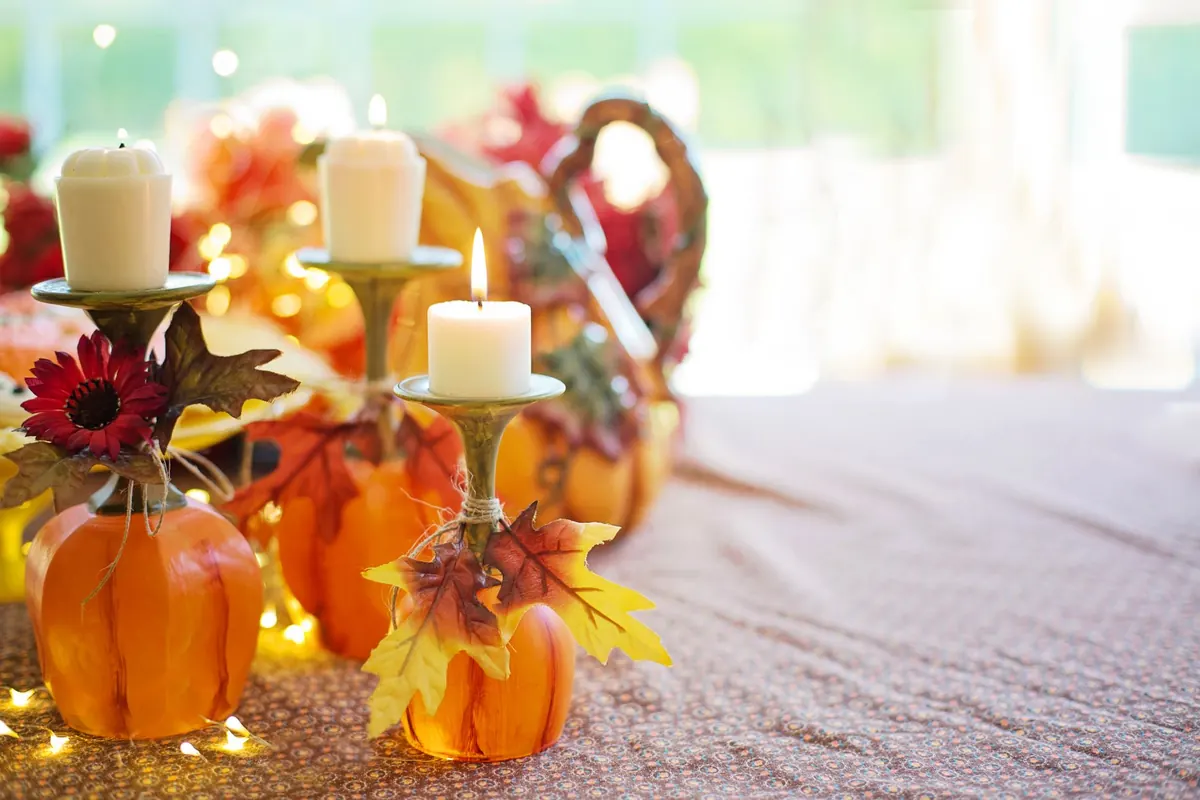
Keep candles well clear of dry branches and never leave one burning once the table has been cleared. Dried material and an open flame are a poor pairing, and a glass holder is not much of a barrier.
Fresh stems need their water changed every other day, and a cool spot overnight will buy you several more. Dry arrangements need the opposite: keep them out of damp and away from a hot radiator, and they will hold for a fortnight or more. Moss is the exception — a light misting keeps it green.
Expect three to seven days of looking genuinely lovely, then a gradual drift into something more sculptural. Curling leaves and fading colour are not failure; they are the season doing its work. When it starts to look tired, change one element rather than starting again — swap the leaves for evergreen, or add a few fresh stones.
A centerpiece has to earn its space. Leave a clear gap at each place setting for glasses and elbows, and keep serving dishes off to one side rather than crowding the middle. Choose a cloth that lets the arrangement speak: plain linen, dark wood, or bare boards rather than a busy print.
One last consideration, easily overlooked. Strongly scented materials — pine, eucalyptus, bay — can compete with the food, and some guests are sensitive to them, so keep the scent light at a meal and save the heavily aromatic branches for the hallway. Then light a candle, sit down, and let the table do what a table is for.
Photo: Jill Wellington / Pexels